









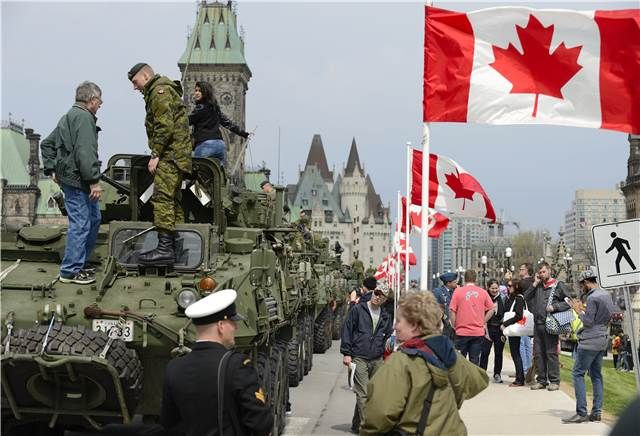
OTTAWA — October 6, 2026: Canada has reorganized the structure of its Army as the federal government continues efforts to modernize the Canadian Armed Forces and improve the country’s ability to respond to security challenges at home and abroad.
The Canadian Army announced the change on October 5, saying it has adopted a new mission-based structure built around four primary formations. The change is intended to give each formation a clearer responsibility and allow the Army to concentrate personnel, equipment and expertise on specific missions.
The four formations are the 1st Canadian Division, based in Edmonton; the 2nd Canadian Division, based in Montréal; the Canadian Army Support Division, based in Kingston; and the Canadian Army Doctrine and Training Centre, also in Kingston.
The restructuring was formally recognized last month, but the announcement comes as Canada is placing greater attention on military readiness, territorial defence, Arctic security and the country’s ability to respond quickly to emergencies.
For the Canadian Army, the change is more than simply moving units from one headquarters to another. Each formation now has a defined role within the wider defence system.
Why Canada is changing the Army’s structure
The Canadian military has been going through a period of modernization as the government looks at how the Armed Forces should operate in a changing security environment.
The Army says the new structure is intended to make it more ready, adaptable and capable of supporting operations both inside Canada and overseas.
Under the previous system, Army formations were organized largely around geographical regions. The new approach places greater emphasis on what each formation is responsible for doing.
That means one formation can concentrate on high-readiness combat forces, another can focus on defending Canada and responding to emergencies, while dedicated organizations handle support and training.
The Canadian Army says this should make it easier to generate forces, integrate capabilities and turn defence investment into operational readiness.
The change also comes at a time when Canada is facing a broader discussion about defence spending and military capacity.
The country has responsibilities at home, including protecting its territory and supporting civil authorities during emergencies, while also maintaining the ability to contribute forces to international operations.
A structure that separates those responsibilities more clearly is intended to make the Army easier to organize and deploy.
What is the 1st Canadian Division responsible for?
The 1st Canadian Division will serve as the Army’s high-readiness formation.
Its primary responsibility is preparing and leading forces for major combat operations and missions outside Canada.
In practical terms, the division is designed to provide a force that can be assembled and deployed when Canada requires a significant land-based military capability.
That could involve an overseas operation with Canadian allies or a major military mission requiring a coordinated land force.
The Army describes the division as the high-readiness component responsible for preparing forces for major combat operations and international deployments.
Having a formation specifically focused on high readiness also creates a clearer distinction between forces prepared for overseas or major combat missions and those primarily responsible for domestic operations.
That distinction can become important when the military is required to respond to more than one situation at the same time.
2nd Canadian Division takes a stronger domestic role
The 2nd Canadian Division, headquartered in Montréal, will have a different focus.
It is being positioned as a foundation for the defence of Canada and will draw on the Regular Force, Army Reserve and Canadian Rangers.
Its responsibilities include domestic land operations, territorial defence, emergency response and sovereignty-related tasks.
This is particularly important for a country as geographically large as Canada.
The Canadian Armed Forces can be called upon to support communities during serious emergencies, including situations where civilian authorities require additional logistical or operational assistance.
The Army’s new structure is intended to make that domestic capability more clearly organized.
The 2nd Canadian Division will also have an important role in mobilization and the generation of Army Reserve capabilities.
That could become increasingly relevant as Canada looks to strengthen its ability to respond across its territory, including northern and remote areas.
The division’s role also connects directly to Canada’s wider concerns about sovereignty.
Canada has the world’s second-largest landmass, with enormous northern and Arctic territories. Maintaining the ability to monitor, operate and respond across those areas requires military forces that can function in difficult environments and work with other government organizations.
The Army Support Division will handle the backbone
Not every military capability needs to be directly involved in combat operations.
The new Canadian Army Support Division, headquartered in Kingston, will provide much of the institutional support required to keep the Army operating.
Its responsibilities include infrastructure, services and technical support.
That may sound less visible than troops deployed on operations, but support systems are essential to military readiness.
Soldiers require bases, equipment, maintenance, transportation, supplies, communications and other services before they can conduct operations.
Separating those institutional responsibilities into a dedicated formation is intended to give the Army a clearer support structure.
It also allows operational formations to concentrate more heavily on their specific missions.
The Army says the Support Division will serve as its institutional backbone and provide the infrastructure, services and technical expertise needed for operations in Canada and overseas.
Training is getting its own dedicated formation
The fourth major component is the Canadian Army Doctrine and Training Centre, which is also based in Kingston.
Its responsibilities include individual and collective training, doctrine development, professional development, experimentation and lessons learned.
This is important because military readiness is not only about having enough personnel and equipment.
Soldiers also need to train for the environments and missions they may encounter.
Modern military operations can involve drones, cyber systems, long-range weapons, advanced surveillance, electronic warfare and increasingly complex coordination between different branches of the armed forces.
A dedicated organization responsible for training and doctrine allows the Army to examine lessons from current operations and exercises and then use that information to update how soldiers are trained.
The centre will also be responsible for experimentation, giving the Army a place to test new ideas and capabilities.
The reorganization does not mean Canada is preparing for war
The announcement has naturally attracted attention because it involves the structure of Canada’s military.
However, the Canadian government has presented the change as part of a broader modernization and readiness programme.
The Army’s announcement does not state that Canada is preparing to enter a war.
Instead, the stated objective is to make the force more prepared for a range of possible missions.
That distinction matters.
Military organizations regularly change their structures as governments adjust defence priorities, technology and operational requirements.
The Canadian Army says its new model is intended to make it more agile and effective and better able to support Canada’s defence at home and abroad.
Arctic security is an important part of the bigger picture
Canada’s northern and Arctic regions are also becoming increasingly important in national defence discussions.
The Arctic is strategically important because of Canada’s geography and its proximity to other countries and major international routes.
Canadian defence officials and security experts have increasingly highlighted the need to strengthen Canada’s ability to operate in northern environments.
Earlier reporting has also pointed to concerns involving Russian military activity, China’s growing interest in the Arctic and the broader strategic importance of the region.
The new Army structure does not create a separate “Arctic Army,” but the stronger domestic and sovereignty role assigned to the 2nd Canadian Division gives the Army a clearer organizational home for missions connected to defending Canadian territory.
The ability to operate in remote locations will remain dependent on more than soldiers alone. Transportation, communications, equipment, infrastructure and cooperation with other federal and territorial organizations are all important.
Canada is also changing its wider defence policy
The Army’s restructuring is happening alongside broader changes in Canadian defence policy.
The federal government has been looking at how to increase defence investment, improve procurement and strengthen Canada’s domestic industrial capacity.
The government also announced a new legislative initiative focused on supporting defence production, procurement and investment, with federal officials scheduled to brief media on the legislation on October 6.
That means the Army reorganization is part of a much larger conversation.
Changing the command structure is one step. The military will also need trained personnel, modern equipment, reliable infrastructure and sufficient funding if the new structure is to deliver the readiness the government wants.
What the new structure could mean for Canadian soldiers
For military personnel, the biggest change will be how units and capabilities are organized around their missions.
Some soldiers will be more closely associated with high-readiness operational forces, while others will work primarily in domestic defence, training or institutional support.
The transition will not happen overnight.
The Army says several modernization initiatives are continuing, and some parts of the new structure will continue developing as personnel, equipment and infrastructure become available.
That means the full impact of the reorganization may not be visible immediately.
The real test will come from how effectively the four formations work together.
A combat formation still needs trained personnel and logistical support. Domestic forces still require equipment and training. Training organizations need feedback from operational units to understand what soldiers need to prepare for.
The new model is therefore intended to create a clearer division of responsibility while keeping the different parts of the Army connected.
Why the change matters beyond the military
Canadian defence policy can sometimes seem distant from everyday life, but military readiness can have domestic consequences.
The Canadian Armed Forces have historically been called upon to support communities during emergencies and natural disasters.
They can provide personnel, transportation, logistics and specialized capabilities when civilian authorities need additional support.
The new structure’s emphasis on domestic defence and emergency response could therefore affect how quickly the Army can organize assistance when a major event occurs.
At the same time, the high-readiness structure gives Canada a clearer mechanism for preparing forces for international commitments.
The government has responsibilities to its allies, and the ability to generate credible forces is an important part of those relationships.
The biggest challenge will be implementation
Changing an organizational chart is relatively straightforward.
Building a stronger military is much harder.
The Canadian Army will need to make sure the new formations have enough personnel, equipment and funding to perform their assigned responsibilities.
Canada has faced long-running challenges involving military recruitment, retention and equipment procurement.
The new structure cannot solve those problems by itself.
It can, however, give the Army a framework for deciding where capabilities should be concentrated and which organizations are responsible for specific missions.
That is why the next few years will be important.
The government will have to demonstrate that increased defence investment is translating into actual capabilities rather than simply new announcements.
What happens next?
The Canadian Army will continue implementing the new structure as personnel, equipment and infrastructure are aligned with the four formations.
The 1st Canadian Division will focus on high-readiness forces and major combat operations.
The 2nd Canadian Division will concentrate on domestic defence, territorial operations, emergency response and sovereignty tasks.
The Canadian Army Support Division will provide institutional infrastructure and support.
The Canadian Army Doctrine and Training Centre will focus on training, doctrine, professional development and experimentation.
Together, those formations are intended to create a more clearly organized Canadian Army.
The government is also continuing broader defence reforms, including work on defence production and procurement.
Final thoughts
Canada’s Army has entered a new phase of organizational change.
The new mission-based structure is designed to give the country’s land forces clearer responsibilities while improving readiness for both domestic and international operations.
For Canadians, the most important part of the announcement is not simply the names of the four formations. It is what happens next.
If the new structure is matched with sufficient personnel, modern equipment, effective training and reliable support, it could give the Canadian Armed Forces a clearer framework for responding to future challenges.
But the reorganization itself is only one part of the process.
The Canadian Army will now have to turn the new structure into practical capability.
That will involve training soldiers, maintaining equipment, improving readiness and ensuring that forces can move quickly when Canada needs them.
For now, the October announcement marks another significant step in Canada’s wider effort to modernize its defence system and strengthen the military’s ability to operate at home and abroad.
Source: Government of Canada, Department of National Defence, Canadian Armed Forces; supporting reporting from Canadian media.